Monthly Archives: February 2020

BeOS | Revolvy

BeOS is an operating system for personal computers first developed by Be Inc. in 1991. It was first written to run on BeBox hardware. BeOS was built for digital media work and was written to take advantage of modern hardware facilities such as symmetric multiprocessing by utilizing modular I/O bandwidth, pervasive multithreading, preemptive multitasking and a 64-bit journaling file system known as BFS. The BeOS GUI was developed on the principles of clarity and a clean, uncluttered design.

The API was written in C++ for ease of programming. It has partial POSIX compatibility and access to a command-line interface through Bash, although internally it is not a Unix-derived operating system. Continue reading
Is BeOS still special? – Ars Technica OpenForum

Source: Is BeOS still special? – Ars Technica OpenForum

BeOS (Other) | VETUSWARE.COM – the biggest free abandonware collection in the universe

VETUSWARE.COM – the biggest free abandonware collection in the universe

Source: BeOS (Other) | VETUSWARE.COM – the biggest free abandonware collection in the universe

Writing a BeOS Replacement – OSnews

Home > BeOS & Derivatives > Writing a BeOS Replacement
Writing a BeOS ReplacementGuest post by Daniel Switkin 2002-09-24 BeOS & Derivatives 185 Comments
Daniel Switkin, a long time BeOS developer and former Be Inc. employee, has submitted an editorial on “Writing A BeOS Replacement“. It aims to bring together the various efforts out there and define a plan which has the greatest chance of success. Click Read More to see the entire article from Daniel.

A few words before we begin:
1. This is not a half-hour brainstorm. I read FAQs, I researched, I thought about it, I wrote it, I put it away, and I rewrote it. Please show me the same courtesy before clicking the Post Comment button.
2. Yes, I am a former Be employee.
3. No, that does not make me right or my opinion more important.

Source: Writing a BeOS Replacement – OSnews

BeOS User’s Guide: Table of Contents

Source: BeOS User’s Guide: Table of Contents

Beos welcome to the 3D world white paper pdf -bros – Google Search

ftp.ntua.gr › mirror › BeOS › docs › UserDoc › BeOSUsersGuide
BeOS User’s Guide – NTUA FTP Server
PDF

Be, the Be logo, BeBox, BeOS, GeekPort, and BeWare are trademarks of Be, Inc. Apple and. Macintosh are registered trademarks … For a detailed discussion of the 3D Kit, see the white paper, “Welcome to the 3D World,” on the Be Web site:.

Source: Beos welcome to the 3D world white paper pdf -bros – Google Search

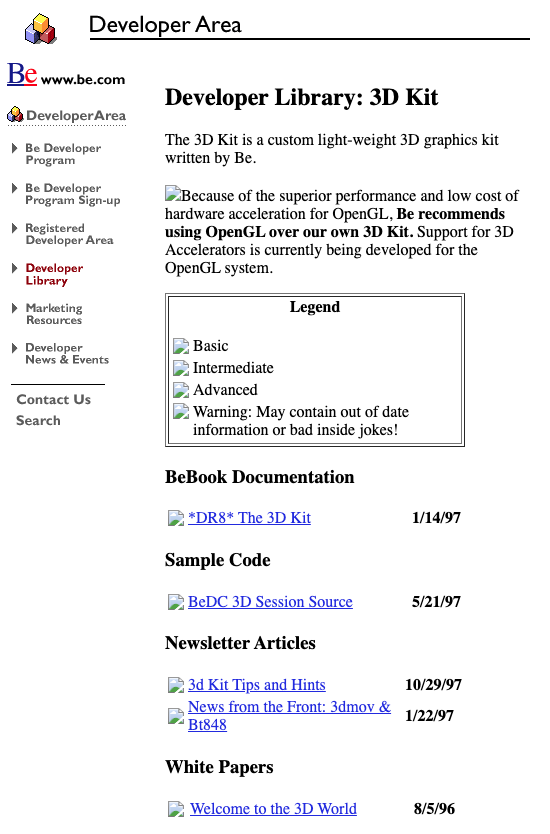
Developer Library: 3D Kit

Developer Library: 3D KitThe 3D Kit is a custom light-weight 3D graphics kit written by Be.Because of the superior performance and low cost of hardware acceleration for OpenGL, Be recommends using OpenGL over our own 3D Kit. Support for 3D Accelerators is currently being developed for the OpenGL system.
Source: Developer Library: 3D Kit

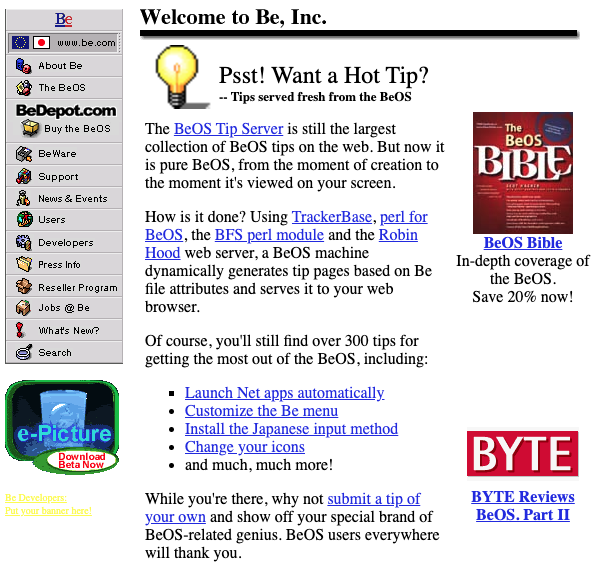
Welcome to Be, Inc.

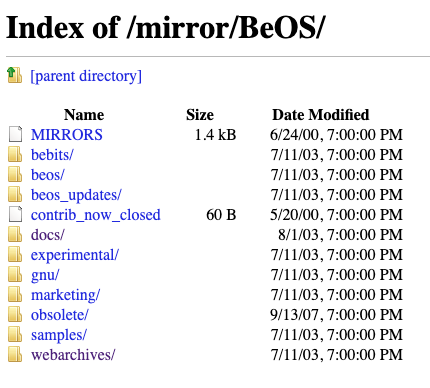
ftp://ftp.ntua.gr/mirror/BeOS

https://www.oreilly.com/openbook/beosprog/book/ch01.pdf

Source: Welcome to Be, Inc.

Andrew Greimann – Medium

Enthusiastic Be/Haiku and Mac geek. Come check out my blog!

Source: Andrew Greimann – Medium

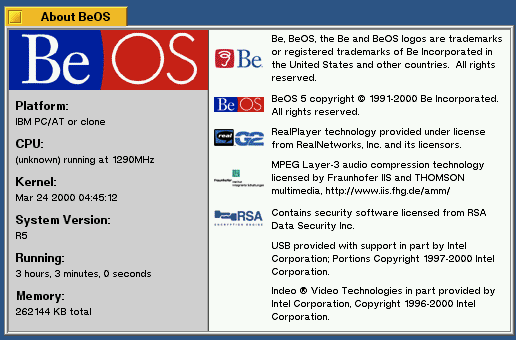
BeOS R5 Review (Part 1 of 3: Desktop, decors, and applications)

The last official version of BeOS would be its most solid yet.

Here we are, after revisiting three versions (3.1, 4.0, and 4.5). We’ve now arrived at the last official release of the BeOS: R5, nicknamed “Maui”. And by far, out of every release, R5 was the most popular as it had went Platinum. Seriously. Picture “over one million copies… downloaded in the first month” and “over four million CDs” according to an Internet Archive Be press release: Be Goes Platinum with BeOS R5, and that should provide an idea of the popularity of Release 5.R5 also solidified the foundation from 4.5, and thanks to the BeOS R5 page on Wikipedia, we can see it mentions R5: “Improved POSIX compliance, particularly in the area of networking” and that “the OS in general was moved towards the new modular media kit over the former audio-only sound subsystem.” Another tidbit that is interesting to note about R5 is that the same page indicates it had been “seeded to developers as ‘R4.6′,” and if so, this would mean 5.0 was probably considered to be an upgrade to 4.5 in its heart and soul.

Source: BeOS R5 Review (Part 1 of 3: Desktop, decors, and applications)